
Last year I read 33 books (including a few graphic novels and short stories). Given it wasn’t too many years back that I was struggling to get myself back into a healthy reading habit I’m pretty happy with that statistic. While 2024 was the year that I plunged into folk horror, last year seemed to be the year that I discovered an appetite for autobiographies with three such books ending up among my favourite reads of the year. Read on to find out about those and my other reading highlights of 2025.
Autobiography
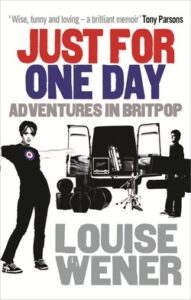
My absolute favourite book of last year turned out to be a reprint of Louise Wener’s 2010 autobiography, Just For One Day. Wener, for those of you who don’t recall the name, was the lead singer of the Britpop band Sleeper (“What do I do now?”). In Just For One Day she recounts her experience of growing up in 1970s England and seeing her dream of becoming a pop star become true. I don’t mind Sleeper but I’m not especially a fan, and Louise Wener was someone I was only vaguely aware of. I grabbed this book because it was cheap and because Britpop formed a big chunk of the background to my young adult life.
Maybe it’s because I also grew up in 1970s England that I connected with Wener’s writing instantly. In some ways it was like reading a book about my own childhood (although Wener’s life and path are, of course, nothing like my own). She brings honesty to her story and while this remains, overall, an entertaining, insightful and engaging read, she never glosses over the fact that the music industry is a hungry, vicious and poisonous business. While Sleeper’s time in the charts was comparatively short this is an oddly redemptive tale. Wener experiences almost everything that the music business has to offer and comes out on the other side with her own life, an independent career, and enough love left for the songs to continue performing them from time to time.
Just For One Day is highly recommended if you’re at all interested in the music business or in Britpop, especially presented from a feminist perspective.
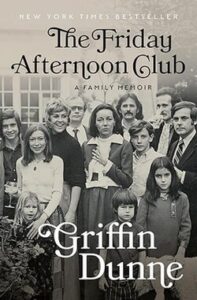
My other favourite book of the year was The Friday Afternoon Club written by Griffin Dunne. Now Dunne is someone I’ve always remembered very fondly from An American Werewolf In London, from After Hours, and a handful of other movies from the 80s that I missed. He was almost big for a while and then kind of faded away.
He starts The Friday Afternoon Club by jumping ahead and recounting the evening he found out that his sister had been murdered. It’s a pretty big hook and it makes sense putting it at the front of his story because it’s the point at which his life tangibly changes.
(Incidentally, it wasn’t until some way into the book that I finally put two and two together and realised that Griffin Dunne’s sister was Dominique Dunne, the young star of Poltergeist who was murdered by her boyfriend shortly after that film was released. I knew about Dominique Dunne—and the ‘Poltergeist curse’—previously, but for some reason it took me all this time to make the obvious link).
As mentioned, The Friday Afternoon Club is a story of two halves. The first is a remarkable tale of growing up in the periphery of Hollywood surrounded by stars, with all the usual struggles to find one’s own path in life. Because Dunne is so warm and honest about his missteps along the way it never seems egregious when he talks about things such as his close friendship with Carrie Fisher and the other various and extraordinary trappings of his life. Eventually Dunne almost makes it big. He’s on his way up. Then the murder happens and his life ends up travelling down a different track as his family seeks justice, deals with injustice, and copes with tragedy.
This is a unique story and what makes it great is Dunne’s personality. He is witty and self-deprecating but doesn’t shy away from the darker aspects of his life; nor does he try to shock the reader or show-off at any point. He simply takes our hand and walks us through his story. I doubt I’ll ever read another story quite like his.
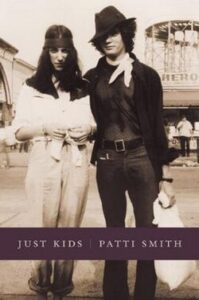
I also want to add a shout out for Patti Smith’s memoir Just Kids. I’m a big admirer of Smith—albeit I’ve only dabbled lightly—and I’ve heard often that her prose is as remarkable as her music. Just Kids tells the story of her younger life, her complex relationship with her soul-mate photographer Robert Mapplethorpe and her first steps into rock-n-roll history.
However, it’s more about the tempestuous path of a life devoted to art. Smith makes it clear that art is the passion and driving force in both her’s and Mapplethorpe’s lives, making her youth a panoply of poverty, hardship, compromises and disappointments.
There are times when you’re almost tempted to see Smith and Mapplethorpe as deranged avant-garde cultists but, once again, honesty is the key here: Smith never portrays herself (or Mapplethorpe) as anything other than what they were or striving to be. There is neither pretence nor pretension and, after all, doesn’t the best art rely on the artist being willing to open up a creative vein and let it all spill out?
Horror
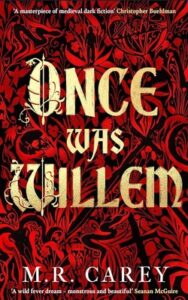
Curiously I read almost no horror novels this year (I had to double check the list but it’s true). So I’m going to cheat slightly and include M.R.Carey’s new Frankensteinesque novel, Once Was Willem in this section. In truth it’s more of a fantasy novel but it has monsters in it so I think I can get away with it.
I’ve enjoyed every one of Carey’s books that I’ve read (I also read one of his sci-fi novels, The Infinity Gate, last year and that was great too) and he never serves up the same dish twice. This is a very different tale to something like The Girl With All The Gifts and one of the things that makes Once Was Willem stand out is the language. It’s a tale set in mediaeval times—the main character being a dead child who has been resurrected in monstrous form—and Carey has clearly done some research in the language patterns of the time as the narration (provided in first person) has a colourful ring of authenticity to it. While I can’t attest to its actual authenticity; I can say that this novel was a joy to read.
Science Fiction
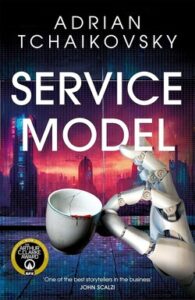
I decided it was time to try out some Adrian Tchaikovsky novels this year (there’s quite a lot of them and they tend to be well received). My favourite one so far—and easily my favourite fiction read of the year—was Service Model, a story about a service robot gradually having its independence foisted upon it despite its best efforts to keep on serving humans cups of tea. There are some sharp observances about AI, our reliance on technology, and life and society in general but this book is so damn funny. Tchaikovsky has effortlessly channelled the spirit of Douglas Adams and crafted a book that has wit and intelligence alongside a compelling (even moving) story.
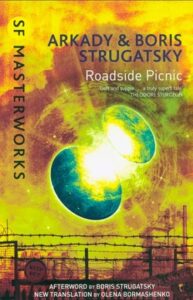
I also started to dabble in some classic science fiction this year, mostly motivated by learning about Roadside Picnic, a novel whose DNA is very clearly embedded in Annihilation (an awesome movie) and the Southern Reach series of books on which that movie is based. Roadside Picnic is a Russian science fiction novel from the 1970s so I expected to be a bit of a slog but it wasn’t at all. The premise, of a ‘forbidden zone’ that holds all manner of dangers—and treasures—following a random visit by long-departed aliens is fascinating, and the array of characters and struggles that the plot navigates us through is more than enough to keep the pace up and keep the brain ticking over at the same time.
Non fiction
I love a good non-fiction book and two of the best that I read this year were on wildly different subjects, albeit both of which I have read extensively about.
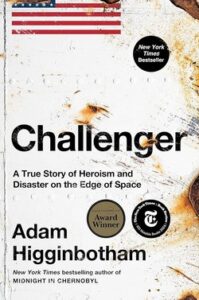
Challenger is about the 1983 space shuttle disaster although the narrative spans from the very early days of the space program and pieces together a history of compromises, bureaucracy, political manoeuvring and questionable decisions—all of which led to the Challenger space shuttle blowing up. It’s a richly detailed book, never gets lost on the way, and gave me a number of fresh insights despite being at least the third book I’ve read on the subject. Adam Higginbotham does an impressive job of juggling the detail of space history, global politics and huge cast of characters without ever overwhelming the reader and, perhaps most importantly, never losing sight of the human story at the core of this tragedy.
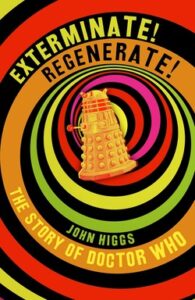
The other non-fiction book that impressed me this year was Exterminate/Regenerate by John Higgs which I picked up because it was cheap and I’m always up for reading some behind the scenes stuff about Doctor Who. What I didn’t expect was for this to be probably the best book about Doctor Who that I’ve read to date. It’s fashioned more along the lines of a biography than a making of and introduces us to some of the key players along the way and their stories, as well as placing each era of Doctor Who into the social context of its time. I learned things about the show, and its creators, that I never knew and, given how long the both the show and myself have been around, that’s no mean feat.
Did you read anything that landed particularly well with you last year? Let me know in the comments so I can perhaps pick up a copy. If this post inspires you to check out any of the books listed above please also let me know.
So far this year I’ve read two and a half novels. See you in twelve months to see how I go for the rest of the year!